Almond Skin Polyphenol Extracts Stimulate the Activation of Diacylglycerol Kinase alpha via a 67 kDa Laminin Receptor
DOI:
https://doi.org/10.31989/ffhd.v12i4.894Abstract
Background: Almond skins are the byproduct of the almond industry that are rich in dietary fibers and polyphenols. Recently, there has been an increasing interest in utilizing the phenolic compounds from almond skins for their functional benefits. Galloylated catechins activate diacylglycerol kinase α (DGKα) which is involved in the amelioration of diabetic nephropathy. Therefore, in this study, we investigated whether almond skin polyphenol extracts can also induce the activation of DGKα.
Methods: Phenolic contents in the almond skin polyphenol extracts were identified by liquid chromatography (LC)-time of flight mass spectrometry (TOFMS). Using confocal microscopy, the translocation of green fluorescent protein (GFP)-DGKα to the cell membrane was observed upon stimulation with almond skin polyphenol extracts. To check the involvement of 67 kDa laminin receptor (67LR), pre-treatment of anti-67LR antibody was used.
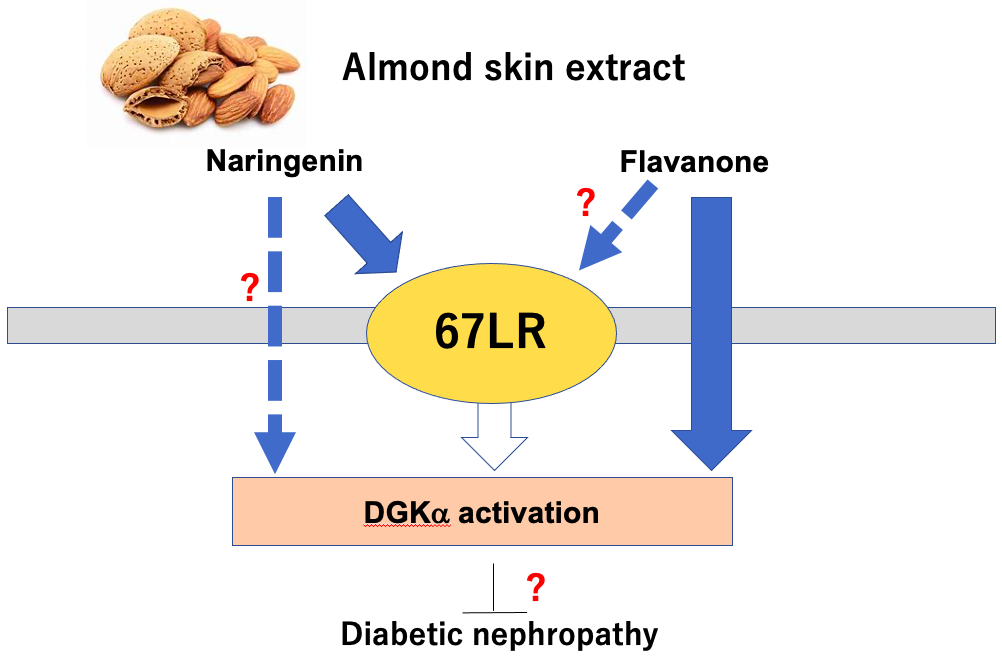
Results: We identified that naringenin and flavanone (2,3-dihydroflavone), which are among the phenolic contents in the almond skin polyphenol extracts identified, can also induce the activation of DGKα. In addition, we also investigated whether the pathway involves the same receptor as that of epigallocatechin-3-gallate (EGCg); the 67LR. Naringenin stimulated through the 67LR, while flavanone mainly used the 67LR-independent pathways.
Conclusion: These findings were additional function of almond skin polyphenol extracts and may implicate the benefits of the intake of nuts in daily diets. Polyphenols can be extracted from almond skins as an inexpensive source. The various health benefits of polyphenols can be applied to functional foods and supplements.
Keywords: flavonoid, lipid kinase, imaging, catechin, vitamin E, diabetic nephropathy
Downloads
Published
Issue
Section
License
Authors retain the copyright of their articles and grant the Functional Food Center (FFC) and its journals the right of first publication under the terms of the Creative Commons Attribution 4.0 International License.
This license permits unrestricted use, distribution, and reproduction in any medium, including commercial use, provided the original author(s) and source are properly credited. Authors may post and share their published work freely, provided that the original publication in this journal is acknowledged.
By submitting to this journal, authors confirm that their manuscripts are original, not under consideration elsewhere, and that they hold the necessary rights to grant this license. The Functional Food Center encourages open scientific exchange and allows derivative and extended works, provided attribution to the original publication is maintained.