The improvement of daily fatigue in women following the intake of maca (Lepidium meyenii) extract containing benzyl glucosinolate
DOI:
https://doi.org/10.31989/ffhd.v12i4.912Abstract
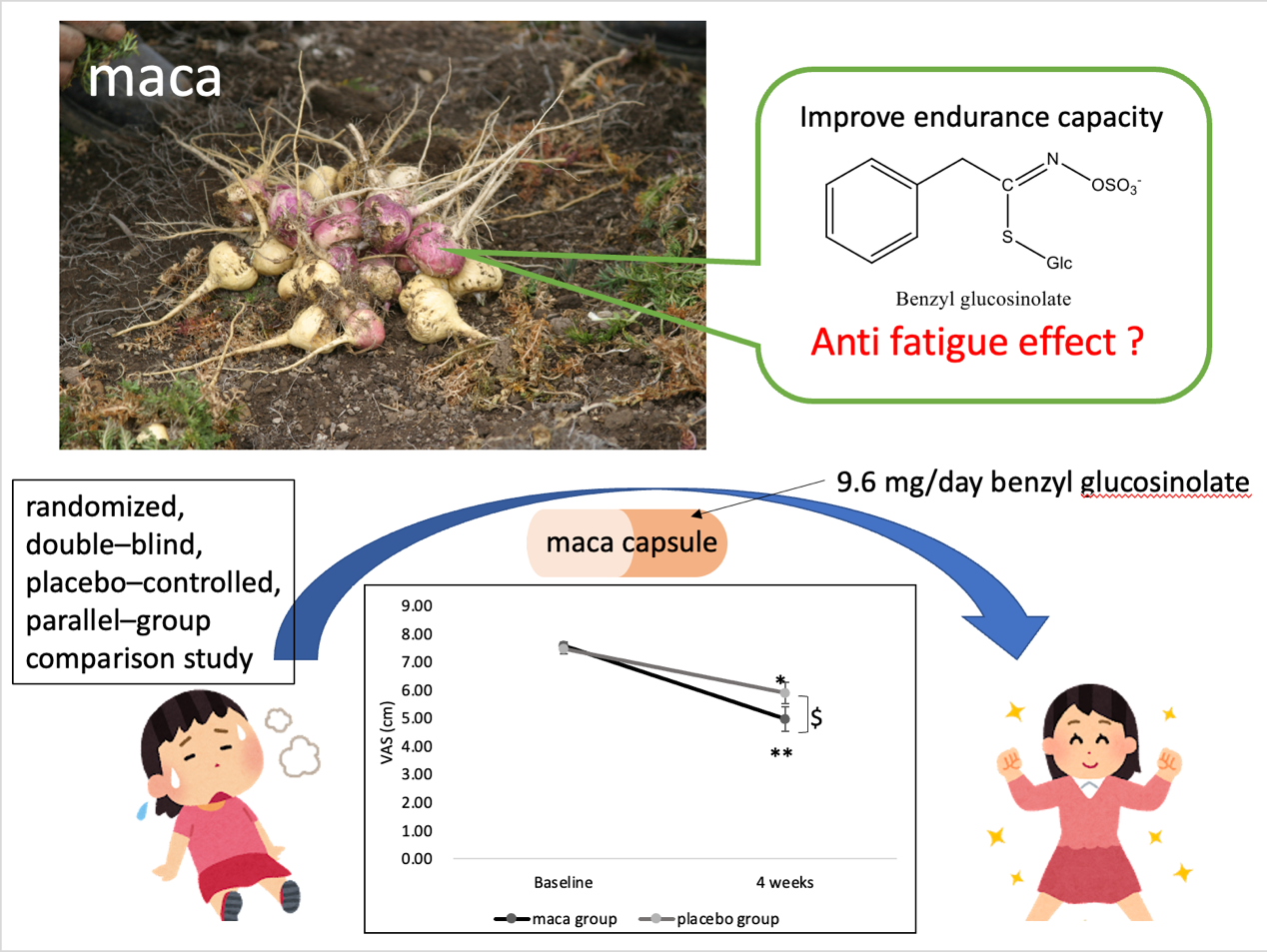
Background: Daily fatigue is a problem for many people because of its association with other illnesses. Maca has lately attracted considerable attention as a food for recovering from fatigue. Maca is high in benzyl glucosinolate which improves endurance capacity by preventing glycogen depletion. However, its effect on fatigue has not been investigated in clinical trials on humans.
Objective: The main objective of this study is to investigate the effects of maca supplements on reducing fatigue.
Methods: This study evaluated the effect of the consumption of maca extract containing benzyl glucosinolate (9.6 mg/day) on fatigue in adult women. This randomized, placebo–controlled, parallel–group double–blind study enrolled 60 subjects who were allocated to consume maca extract or placebo for 4 weeks. A visual analogue scale (VAS) for fatigue was used to evaluate the results. Blood variables and adverse events were used to assess safety.
Results: In both groups, the VAS of fatigue was decreased after 4 weeks compared with that before consumption. On stratification analysis, in subjects younger than 45 years, the VAS was significantly lower in the maca group, and the change between before and after supplementation was significantly larger in this group.
Conclusions: It was suggested that intake of maca extract containing benzyl glucosinolate may have anti–fatigue effects in young women. So, maca supplements containing benzyl glucosinolate represent a food and drug candidate for reducing fatigue.
Keywords: maca, Lepidium meyenii, benzyl glucosinolate, daily fatigue, visual analogue scale
Downloads
Published
Issue
Section
License
Authors retain the copyright of their articles and grant the Functional Food Center (FFC) and its journals the right of first publication under the terms of the Creative Commons Attribution 4.0 International License.
This license permits unrestricted use, distribution, and reproduction in any medium, including commercial use, provided the original author(s) and source are properly credited. Authors may post and share their published work freely, provided that the original publication in this journal is acknowledged.
By submitting to this journal, authors confirm that their manuscripts are original, not under consideration elsewhere, and that they hold the necessary rights to grant this license. The Functional Food Center encourages open scientific exchange and allows derivative and extended works, provided attribution to the original publication is maintained.