Prebiotic properties of isomaltooligosaccharides from cassava as a potential ingredient in high-protein drinks for athletes
DOI:
https://doi.org/10.31989/bchd.v6i3.1063Abstract
Background: Studies show that prebiotics can improve the health of athletes. Isomaltooligosaccharide (IMO) is a food ingredient containing prebiotic properties.
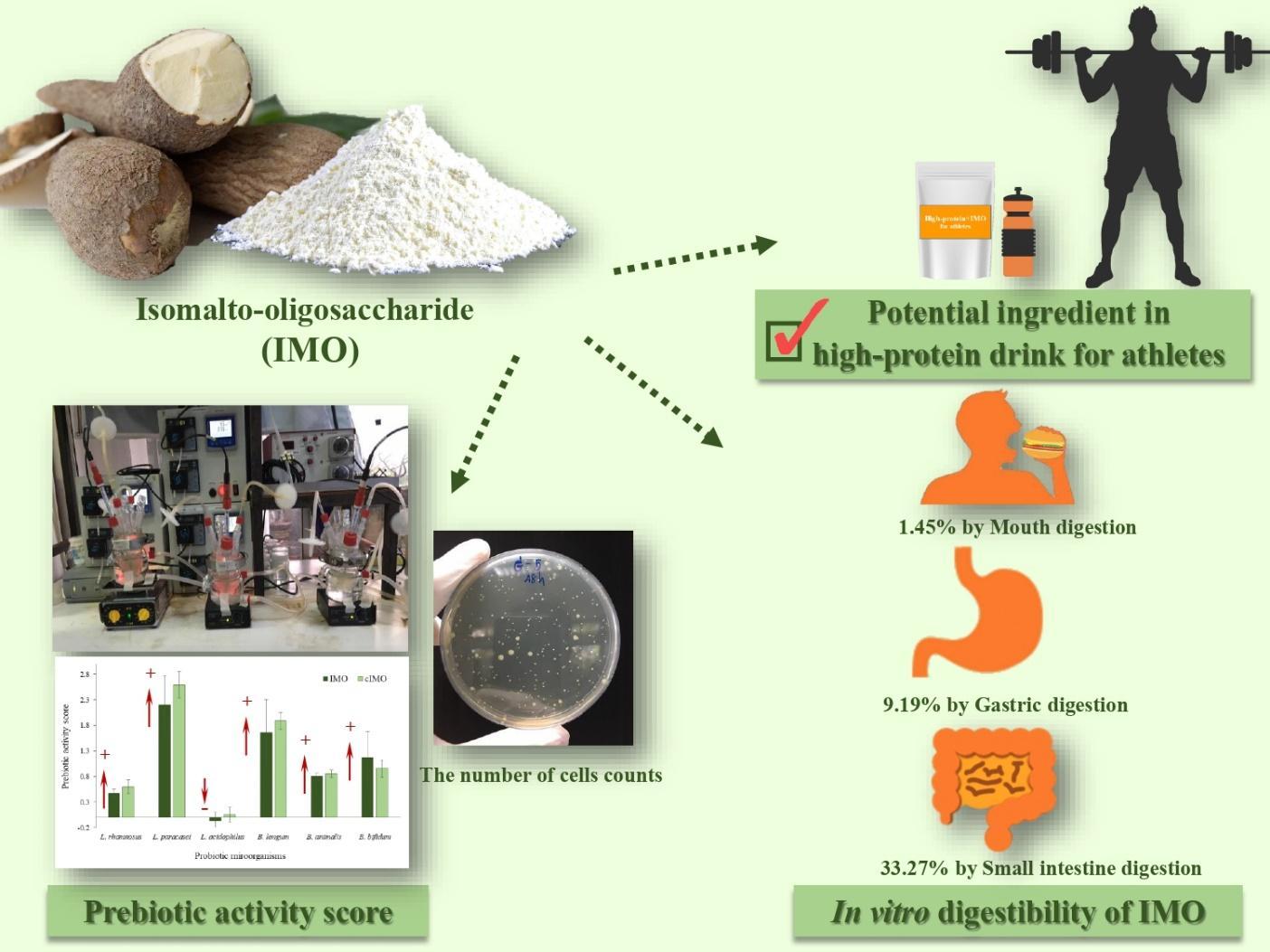
Objectives: The purpose of the study is to examine the prebiotic properties of isomaltooligosaccharides based on digestibility of in vitro under-simulated upper-gut conditions and a prebiotic activity score. Additionally, the study explores the potential to use IMO as an ingredient for high protein drinks.
Methods: IMO powder from cassava starch was prepared through enzymatic methods. The prebiotic properties of IMO were evaluated based on in vitro digestibility and a prebiotic activity score. Researchers assessed the digestibility of in vitro in simulated upper-gastrointestinal-tract conditions, consisting of mouth digestion, gastric digestion, and small-intestine digestion. The study calculated the probiotic activity score according to the number of growing beneficial and harmful bacteria. Finally, researchers determined the potential to use IMO as an ingredient for developing high-protein drink products.
Results:The digestion of IMO by simulated salivary fluid using human salivary α-amylase for 2 min, artificial human gastric juice at pH 2.0 for two hours, intestinal fluid with pancreatic α-amylase (0.75 unit/mL), and pancreatic lipase (1.6 unit/mL) for two hours with a pH of 6.9 and a temperature of 37 oC were 1.54±0.33%, 9.19±0.64%, and 33.27±4.09%, respectively. Comparing the results with commercial isomaltooligosaccharide (cIMO), researchers found that the percentage of digestion differed significantly. Prebiotic activity scores of IMO for L. rhamnosus LGG®, L. paracasei CASEI 431®, L. acidophilus LA 5, B. longum DSM 219, B. animalis subsp. BB12® and B. bifidum BB536 were 0.477±0.07, 2.197±0.58, -0.058±0.16, 1.660±0.63, 0.801±0.59 and 1.179±0.05, respectively. Notably, the results were not significant when compared to cIMO. Researchers measured the nutritional formula in a high-protein drink containing IMO at 40 g (30 g protein) and the total serving at 148 kcal. For macronutrient distribution, the ratio of protein, carbohydrate, and fat in the product is 81:19:0. Micronutrients were added, comprising of 0-50% Thai RDI. Finally, the product also met relevant standards for the microbial quality of food products in powdered form.
Conclusion:IMO from cassava was partially resistant to in vitro digestion under simulated upper-gastrointestinal conditions and promoted the growth of probiotic bacteria. Moreover, powdered IMO can be used as an ingredient for high-protein drink products.
Keywords: prebiotic, probiotic, high protein drinking, athletes, IMO
Downloads
Published
Issue
Section
License
Authors retain the copyright of their articles and grant the Functional Food Center (FFC) and its journals the right of first publication under the terms of the Creative Commons Attribution 4.0 International License.
This license permits unrestricted use, distribution, and reproduction in any medium, including commercial use, provided the original author(s) and source are properly credited. Authors may post and share their published work freely, provided that the original publication in this journal is acknowledged.
By submitting to this journal, authors confirm that their manuscripts are original, not under consideration elsewhere, and that they hold the necessary rights to grant this license. The Functional Food Center encourages open scientific exchange and allows derivative and extended works, provided attribution to the original publication is maintained.