Anti-inflammatory effects of anthraquinones of Polygonum multiflorum roots
DOI:
https://doi.org/10.31989/bchd.v5i6.948Rezumat
Background: The roots of Polygonum multiflorum Thunberg (Polygonaceae) are a crude drug known as Kashu and are thought to improve blood deficiency as a Kampo concept. Kashu is added to Kampo formulas, including Tokiinshi, which is used to treat eczema and dermatitis with itchiness by facilitating blood circulation in the skin. Although anti- inflammatory effects were expected, the reports on anti-inflammatory constituents of Polygonum roots are very few.
Objective: To purify pharmacologically active constituents from Polygonum roots and compare their anti- inflammatory potency using hepatocytes.
Methods: Polygonum roots were extracted and fractionated based on hydrophobicity to three fractions, the ethyl acetate (EtOAc)-soluble, n-butanol-soluble, and water-soluble fractions. Constituents were purified from the EtOAc- soluble fraction, and its contents were measured using liquid chromatography-triple quadrupole mass spectrometer. The interleukin (IL)-1β-induced production of nitric oxide (NO), a proinflammatory mediator, in rat hepatocytes was monitored to assess anti-inflammatory activity.
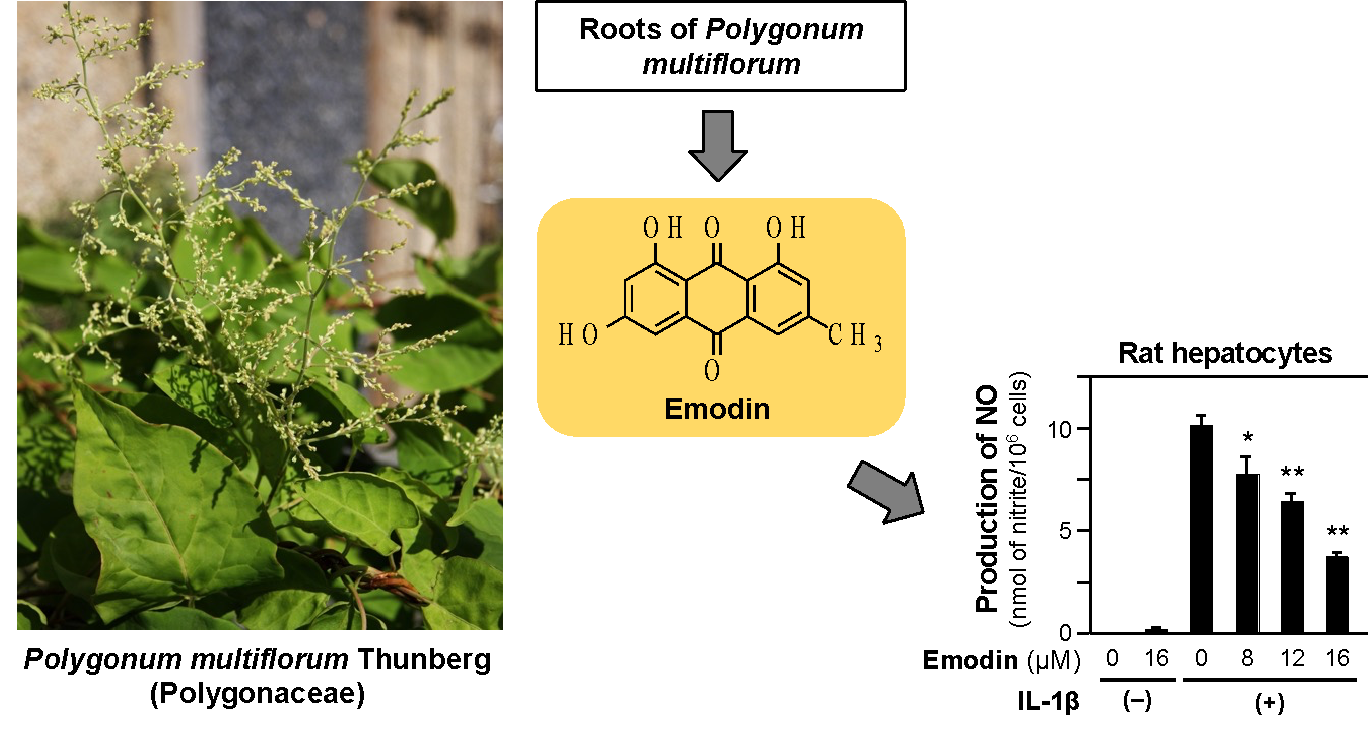
Results: The EtOAc-soluble fraction inhibited IL-1β-induced NO production, whereas the other fractions did not. Six constituents were isolated from the EtOAc-soluble fraction and identified as (E)-2,3,5,4'-tetrahydroxystilbene-2-O-β- D-glucoside, emodin, emodin-8-O-β-D-glucopyranoside, physcion, physcion-8-O-β-D-glucopyranoside, and catechin. Emodin and emodin-8-O-β-D-glucopyranoside significantly inhibited NO production in hepatocytes, and the others showed less potency in suppressing NO production. These two anthraquinones decreased the protein and mRNA levels of inducible NO synthase, as well as the mRNA levels of tumor necrosis factor α. In a search of the literature to date, the comparison of pharmacological activity of the constituents of Polygonum roots was not reported.
Conclusion: These results suggest that hydrophobic constituents in the EtOAc-soluble fraction, especially anthraquinones, may exert the anti-inflammatory effects by treatment with Polygonum roots.
Keywords: anthraquinone, nitric oxide, inflammation, Kampo medicine, LC–MS/MS.
Publicat
Număr
Secțiune
Licență
Copyright (c) 2022 FFC/Bioactive Compounds in Health and Disease

Această lucrare este licențiată în temeiul Creative Commons Attribution-NonCommercial 4.0 International License.
Authors retain the copyright of their articles and grant the Functional Food Center (FFC) and its journals the right of first publication under the terms of the Creative Commons Attribution 4.0 International License.
This license permits unrestricted use, distribution, and reproduction in any medium, including commercial use, provided the original author(s) and source are properly credited. Authors may post and share their published work freely, provided that the original publication in this journal is acknowledged.
By submitting to this journal, authors confirm that their manuscripts are original, not under consideration elsewhere, and that they hold the necessary rights to grant this license. The Functional Food Center encourages open scientific exchange and allows derivative and extended works, provided attribution to the original publication is maintained.