Evaluation of the antioxidant activity and nitric oxide production effect of formulated crispy vegetables from thermal processing of Amaranthus viridis and Sauropus androgynous
DOI:
https://doi.org/10.31989/ffhd.v13i9.1116Abstract
Background: Amaranthus viridis and Sauropus androgynous are common edible vegetables consumed by the natives of Asia. This research aimed to carry out a comparative evaluation on the antioxidant activity and nitric oxide production effect of crispy vegetables formula of A. viridis and S. androgynous made by thermal processing.
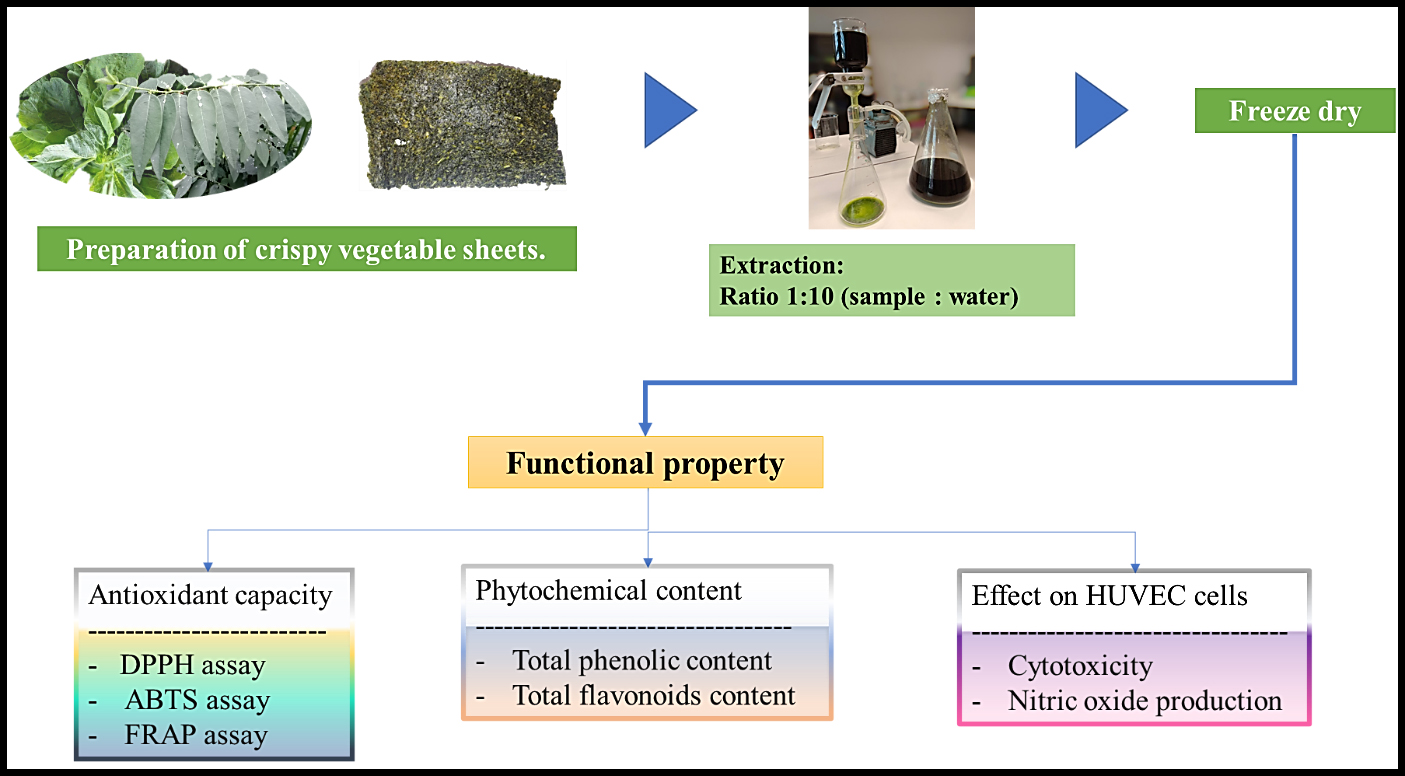
Methods: A. viridis and S. androgynous fresh vegetable leaves were dried, processed and formulated into crispy vegetables: A. viridis crispy vegetables, S. androgynous crispy vegetables and 50:50% (w/w) mixture of A. viridis and S. androgynous crispy vegetables. Total phenolic and flavonoids contents of the three crispy vegetables were evaluated using Folin Ciocalteu colorimetric and aluminum chloride assay.
Results: S. androgynous crispy vegetable had higher phenolic (36.55 ± 0.01 mg GAE/g) and flavonoid (81.17±0.00 mg QE/g) contents than A. viridis crispy vegetables (16.55±0.00 mg GAE/g and 40.58±0.01 QE/g respectively) and 50:50% mixed crispy vegetable formula of A. viridis and S. androgynous (26.01 ± 0.00 mg GAE/g; 59.38±0.00 QE/g respectively). S. androgynous crispy vegetable sheet also demonstrated a better antioxidant activity against the radical effect of DPPH (15.43±0.07%), ABTS (34.04±0.05%) and FRAP (1.73±0.01) than A. viridis (13.45±0.11%, 26.35±0.17 &; 1.56±0.01 respectively) and was comparable with mixed formula (14.23±0.43%; 32.31±0.12%, 1.81±0.03 respectively). A significant dose-dependent cytotoxic effect was induced by the three crispy vegetables with IC50 of 8.33±0.69, 7.84±0.35, 7.86±0.33 respectively on HUVECs. The results also showed that mixed crispy vegetables (50:50%) promoted endothelial nitric oxide production.
Conclusion:The study concludes that the antioxidant activity of the crispy vegetables reflects the total phenolic and total flavonoid content as their functional properties. Our findings also suggest that thermal processing of foods could have significant effect on the antioxidant activity of functional foods; however, A. viridis and S. androgynous prepared in crispy form may pose no potential threat to the body like the fresh vegetables.
Keywords:Amaranthus viridis, S. androgynous, crispy vegetables, antioxidant, nitric oxide, hypertension, Thailand
Downloads
Published
Issue
Section
License
Authors retain the copyright of their articles and grant the Functional Food Center (FFC) and its journals the right of first publication under the terms of the Creative Commons Attribution 4.0 International License.
This license permits unrestricted use, distribution, and reproduction in any medium, including commercial use, provided the original author(s) and source are properly credited. Authors may post and share their published work freely, provided that the original publication in this journal is acknowledged.
By submitting to this journal, authors confirm that their manuscripts are original, not under consideration elsewhere, and that they hold the necessary rights to grant this license. The Functional Food Center encourages open scientific exchange and allows derivative and extended works, provided attribution to the original publication is maintained.