Lime peel as a potential functional ingredient for chronic inflammation treatment
DOI:
https://doi.org/10.31989/bchd.v6i7.1136Abstract
Background: Lime peel, derived from Citrus aurantifolia Swingle, is an ingredient that is frequently discarded despite possessing exceptionally high functional food properties. It contains phytochemicals with health-promoting properties, several of which are reported to have anti-inflammatory properties. However, the specific mechanisms underlying their anti-inflammatory properties have not been elaborated. This study aimed to evaluate the potential use of lime peel as a functional food ingredient for chronic inflammation treatment via the inhibition of macrophage migration inhibitory factor (MIF) activity. MIF is a pro-inflammatory mediator that plays a vital role in the progression of inflammation. This activity of MIF is associated with the pathogenesis of chronic inflammation.
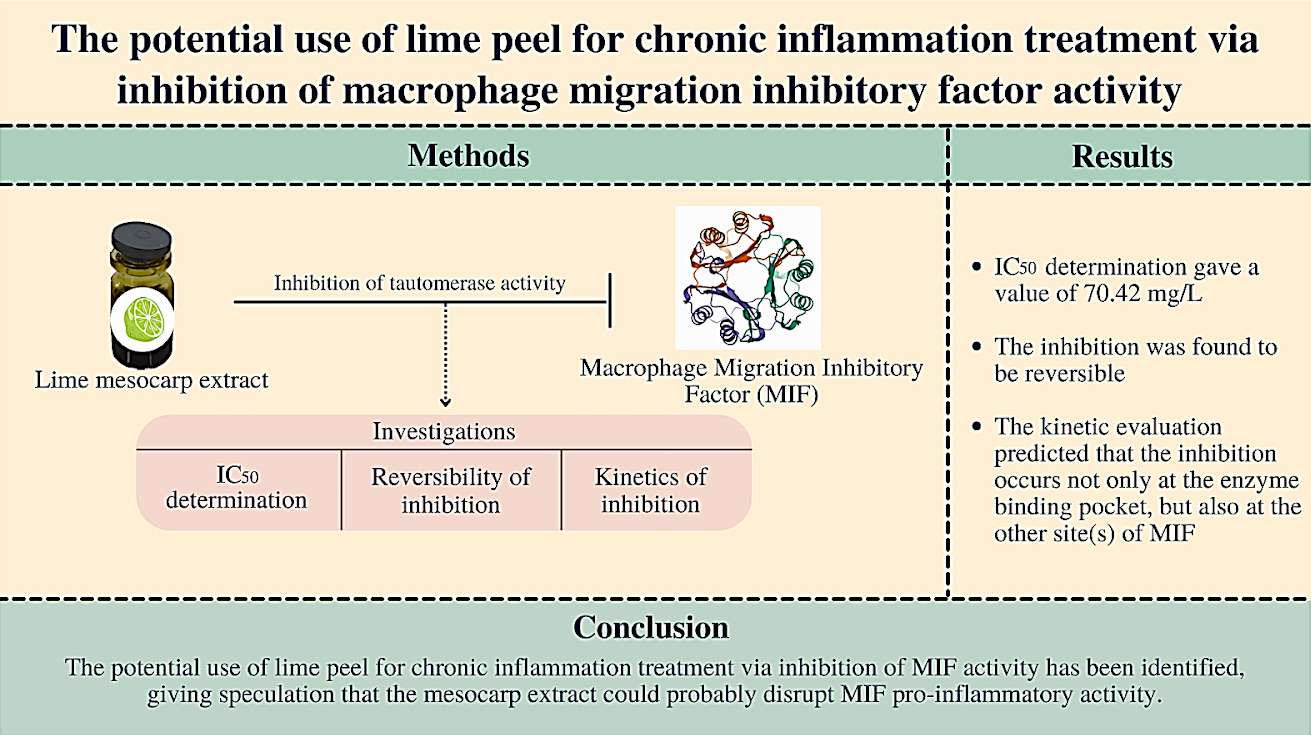
Methods: The inhibition of MIF activity could be used as an approach to identify the potential use of a functional food ingredient for chronic inflammation treatment. This study focused on the investigation of the inhibitory potential, reversibility, and kinetics of lime mesocarp extract on MIF tautomerase activity.
Results: The results showed that the lime mesocarp extract can inhibit MIF tautomerase activity with an IC50 of 70.42 mg/L in a reversible manner, demonstrating its safe potential for use. The kinetic evaluation predicted that the inhibition occurs not only at the enzyme binding pocket but also at the other site(s) of MIF, speculating the possibility of disruption in MIF pro-inflammatory activity.
Conclusion: The potential safe use of lime peel as a functional food ingredient for chronic inflammation treatment has been identified.
Keywords: Lime peel, functional food ingredient, chronic inflammation, macrophage migration inhibitory factor, reversible inhibitor.
Downloads
Published
Issue
Section
License
Authors retain the copyright of their articles and grant the Functional Food Center (FFC) and its journals the right of first publication under the terms of the Creative Commons Attribution 4.0 International License.
This license permits unrestricted use, distribution, and reproduction in any medium, including commercial use, provided the original author(s) and source are properly credited. Authors may post and share their published work freely, provided that the original publication in this journal is acknowledged.
By submitting to this journal, authors confirm that their manuscripts are original, not under consideration elsewhere, and that they hold the necessary rights to grant this license. The Functional Food Center encourages open scientific exchange and allows derivative and extended works, provided attribution to the original publication is maintained.