Chemical, microbial and safety profiling of a standardized Withania somnifera (Ashwagandha) extract and Withaferin A, a potent novel phytotherapeutic of the millennium
DOI:
https://doi.org/10.31989/ffhd.v13i2.1071Abstract
Background:Withania somnifera (L.) Dunal, popularly known as Ashwagandha, is an ethnomedicinal plant with multiple pharmacotherapeutic applications. The diverse medicinal properties of the plant are largely due to the presence of withanolides, a group of C28 ergostane based steroidal lactones, with several sites of unsaturation and oxygenation. Withaferin A, a major with anolide present in Ashwagandha plant accounts for its emerging new roles to treat cancer, arthritis, inflammatory responses, immunomodulatory properties, and neuronal disorders. The root and leaf extracts are specifically important constituent materials for the development of phytotherapeutics, mostly intended for oral consumption. Several studies have been carried out to delineate the toxic manifestations of the extract for human consumption.
Objective:Establish the broad-spectrum safety of W-ferinAmax ashwagandha (WFA).
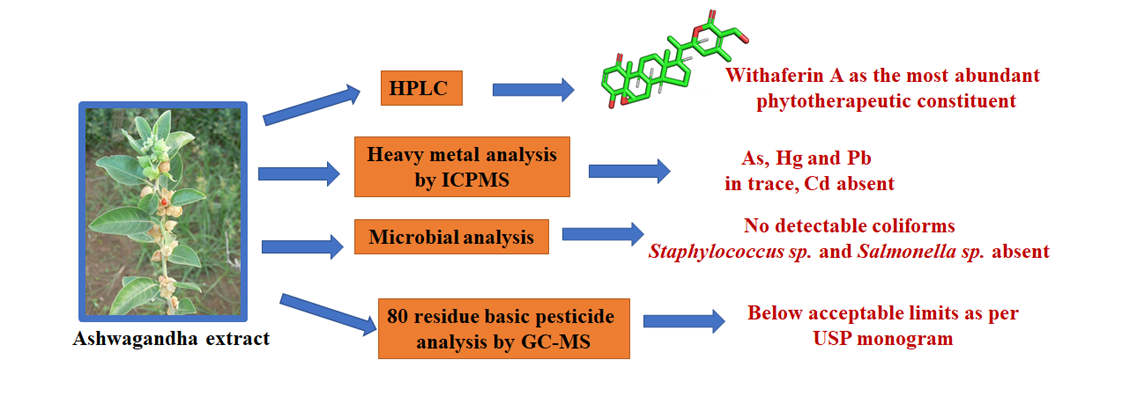
Study: This investigation demonstrated a novel, standardized W-ferinAmax ashwagandha (WFA) extraction technology from the whole herb of Withania sominfera, conducted HPLC analysis to identify the constituents, detected the heavy metals, microbiological contaminants, pesticides contaminants, and safety profile.
Results:A novel extraction technology was employed to obtain WFA from the whole plant of Withania sominfera. HPLC analysis revealed that WFA contains a total of 15.4% Withanolides. In particular, Withaferin A, Withanoside IV, and Withanolide A contents were 6.469%, 1.022%, and 0.073%, respectively. The extract contained only 0.403 ppm of heavy metals out of which traces of arsenic, mercury and lead were detected, and cadmium was absent. USP recommended 80 residue basic pesticide screen indicated that the extraction was safe for human consumption. It was also found to be free from pathogenic microbes as assessed by the absence of E. coli and other coliforms, Salmonella and Staphylococcus species.
Conclusion: The data generated cumulatively indicated that WFA is safe for further downstream processing to and for human consumption.
Keywords: Ashwagandha, Withaferin A, phytotherapeutics, material safety; heavy metals; pesticides
Downloads
Published
Issue
Section
License
Authors retain the copyright of their articles and grant the Functional Food Center (FFC) and its journals the right of first publication under the terms of the Creative Commons Attribution 4.0 International License.
This license permits unrestricted use, distribution, and reproduction in any medium, including commercial use, provided the original author(s) and source are properly credited. Authors may post and share their published work freely, provided that the original publication in this journal is acknowledged.
By submitting to this journal, authors confirm that their manuscripts are original, not under consideration elsewhere, and that they hold the necessary rights to grant this license. The Functional Food Center encourages open scientific exchange and allows derivative and extended works, provided attribution to the original publication is maintained.